You’re undercharging.Here’s the maths.

Work out what every piece really costs you. Give it a price that pays you for your time and still leaves a profit. And say that number to a customer without flinching! You can do it in an afternoon.

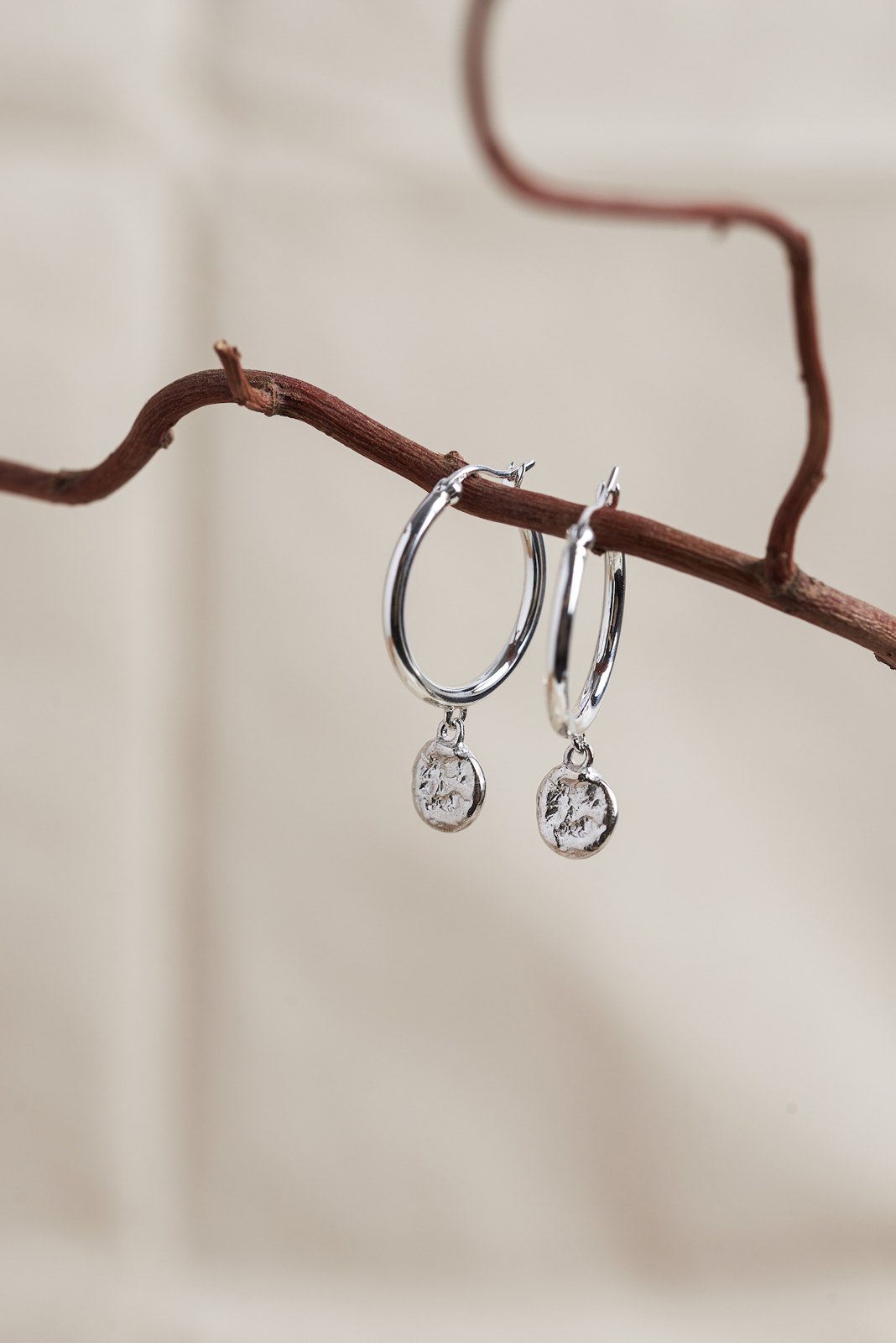
The sheet you get, doing the sums on a pair of studs.

Run your best seller through the 5 checks every price in the course has to pass.

  1. Does it pay your hour?

    Your materials, plus your time at a real hourly rate, plus the box, are all inside the price.

  2. Would it survive a shop?

    If a shop asked tomorrow, half of your price would still cover the piece and pay you.

  3. Could you make enough of them?

    At this price, the number you'd have to sell in a year fits inside your bench hours.

  4. Did you check it against makers, not factories?

    The prices you compared it with were set by people who are paid for their hours.

  5. Can you say it out loud without flinching?

    At a market, in a message, to a shop. The same number, no apology.

Think of your best seller and the price it has today.

Featured in & stocked by

  • Vogue
  • Tatler
  • Glamour
  • Swarovski
  • Anthropologie
  • Museum of London
  • Yorkshire Sculpture Park
  • E.C. One, The Jewellers
  • Wolf & Badger
  • Not On The High Street
  • New Ashgate Gallery
  • The Biscuit Factory
  • Craft & Design
  • Bold Journey
  • Most Curious wedding show
  • Material Driven
  • Woodland Mod
  • Cphagen, Nordic Happiness

“Oh, too cheap.What a shame.”

I was at a market once. A woman picked up a pair of earrings, loved them, asked the price. I said £50. She said “oh, too cheap, what a shame, I wanted something more expensive,” put them down and walked off. She wanted the price to tell her the piece was special. It didn’t.

The Crafts Council asked over 1,000 UK makers what they earned from making in 2024. Half earned under £10,000 in the year. Most of the prices you scroll past were set by people who aren't paid for their hours. So if you copy their prices, you end up earning what they earn.

A price isn’t something you guess at until it feels about right. It’s your silver at today’s price, your time at a real hourly rate, the box, and enough room for a shop’s margin. The course takes you through it in that order, and gives you the sheet that does the sums for you.

Megan

What a pair of studsreally costs

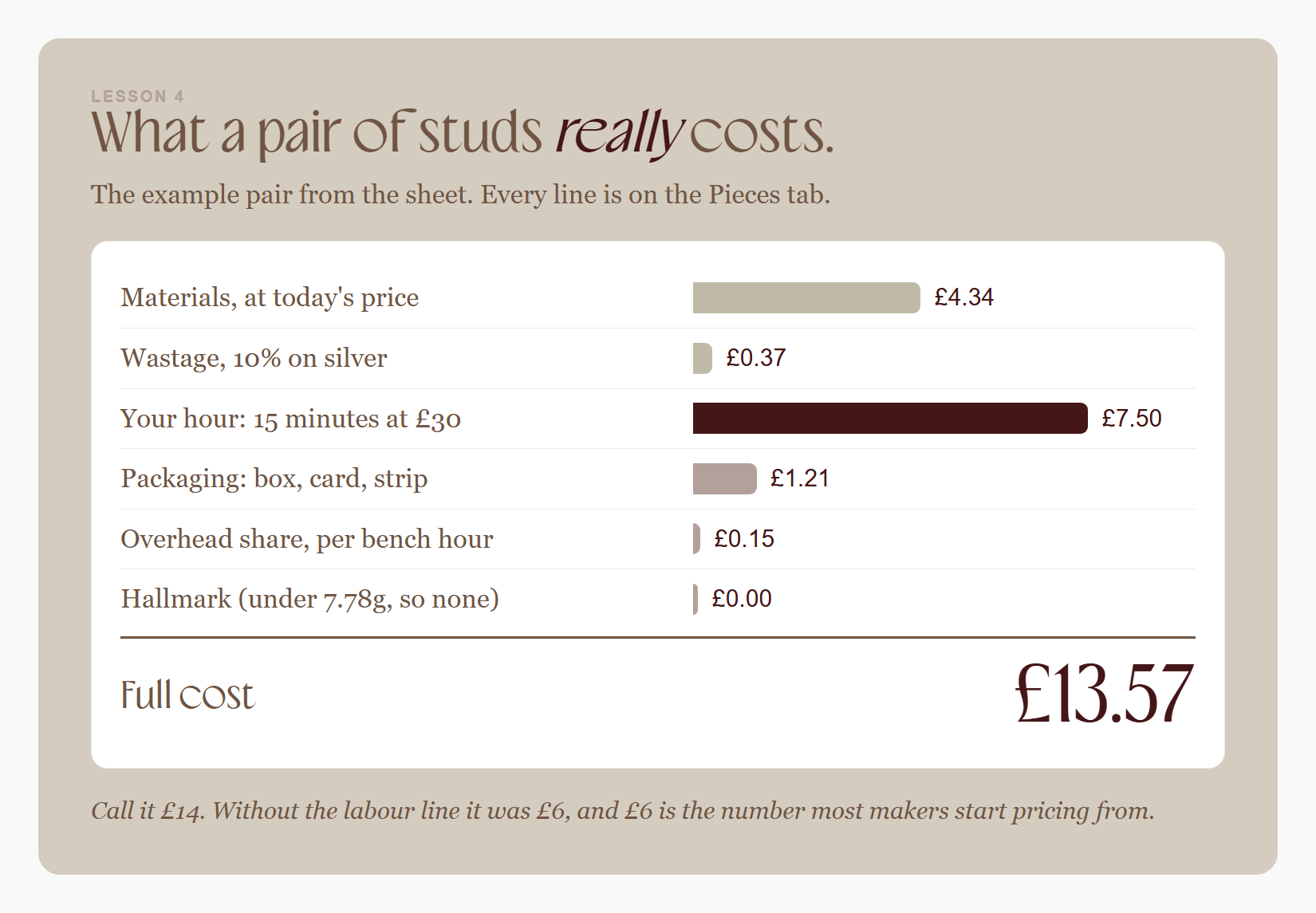
The example that runs through every lesson, straight from the sheet. 15 minutes at the bench, 1.6g of silver, a box. Nothing invented and nothing left out.

At the old price she was paid for the silver and not much else. At the new one the business keeps about £55 on every pair, and a shop can still stock them.

Materials, at today’s price
£4.34
Your hour, 15 minutes at £30
£7.50
The box and a share of overheads
£1.36
Full cost
£13.57
Wholesale, times 2
£0
On the shelf, times 2.5
£0
Her old price
£35

16 lessons in 6 parts, in the order the price gets built

    Start here

    Why you can't compete with a factory, the 3 tiers of jewellery, the 10-second impossible-price test, and why a low price costs you sales.

    What a piece really costs

    Materials at today's price, your hour (a floor, a working rate and a target), timing the batch, and the small costs you've been absorbing.

    Building the price

    The chain from cost to wholesale to shelf, 3 models for silver, gold and beads, whole numbers, your ladder, and the 5 checks.

    Comparing carefully

    The 5 matching rules, the 7 reseller tells, and the shape of the market, so other people's prices stay a sanity check and never become yours.

    Fees, shops and what you keep

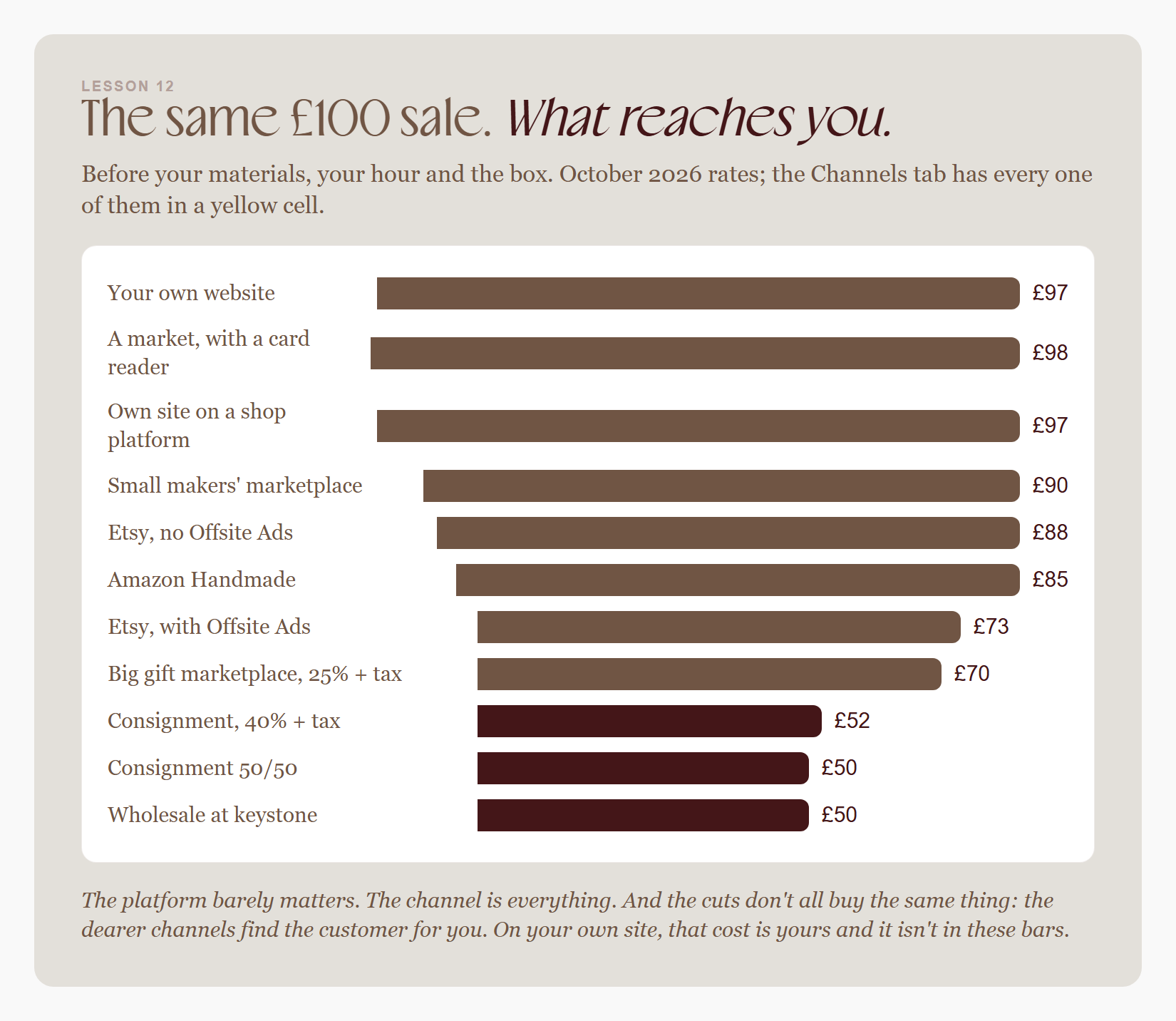
    The same £100 sale on 12 channels, wholesale and consignment done properly, free shipping, discounts and the tax line.

    The special cases, then say it

    Commissions and bespoke, what you're allowed to call your metal, how to raise a price and hold it, and the 3 scripts for saying the number.

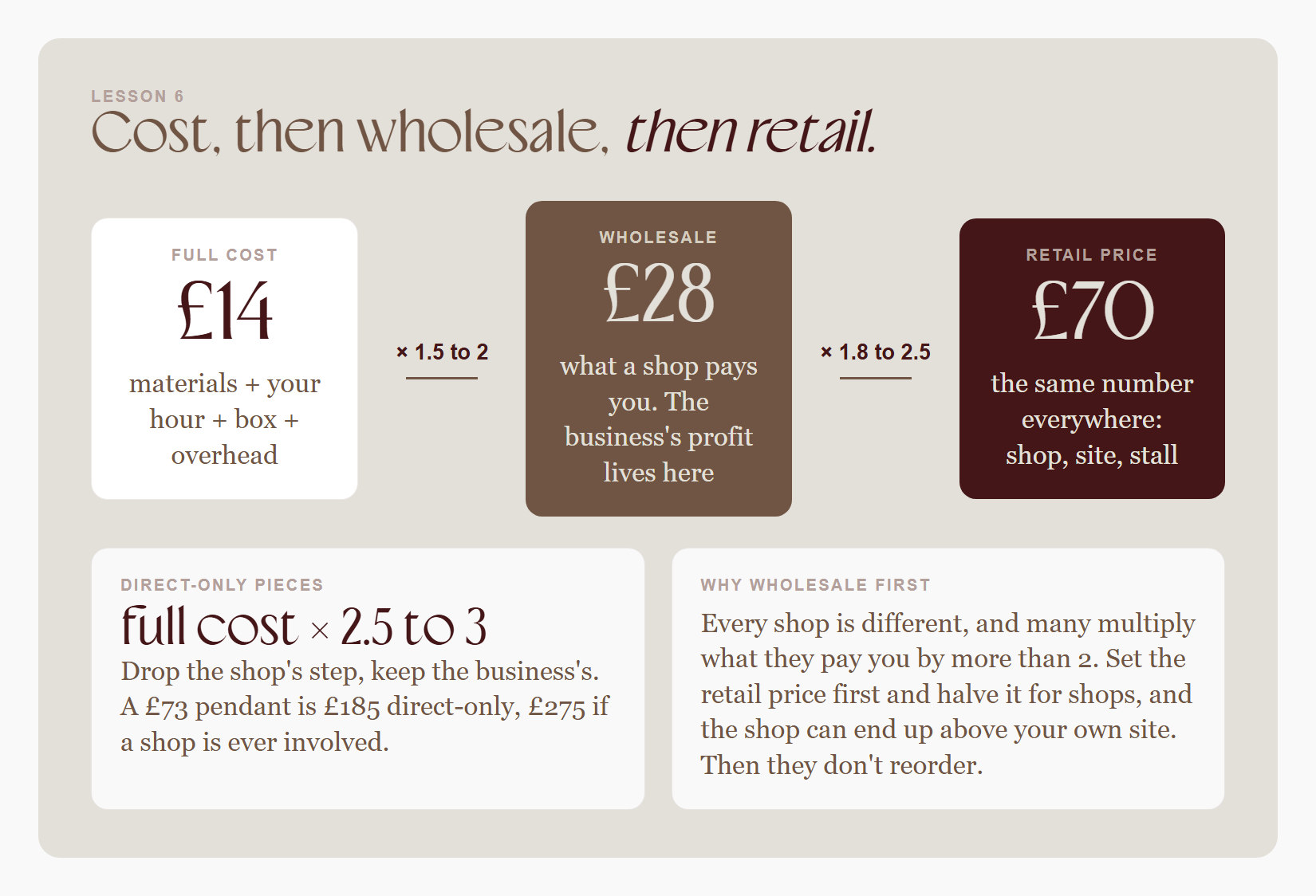
The chain: full cost £14, wholesale £28, shelf £70
What a pair of studs really costs, line by line
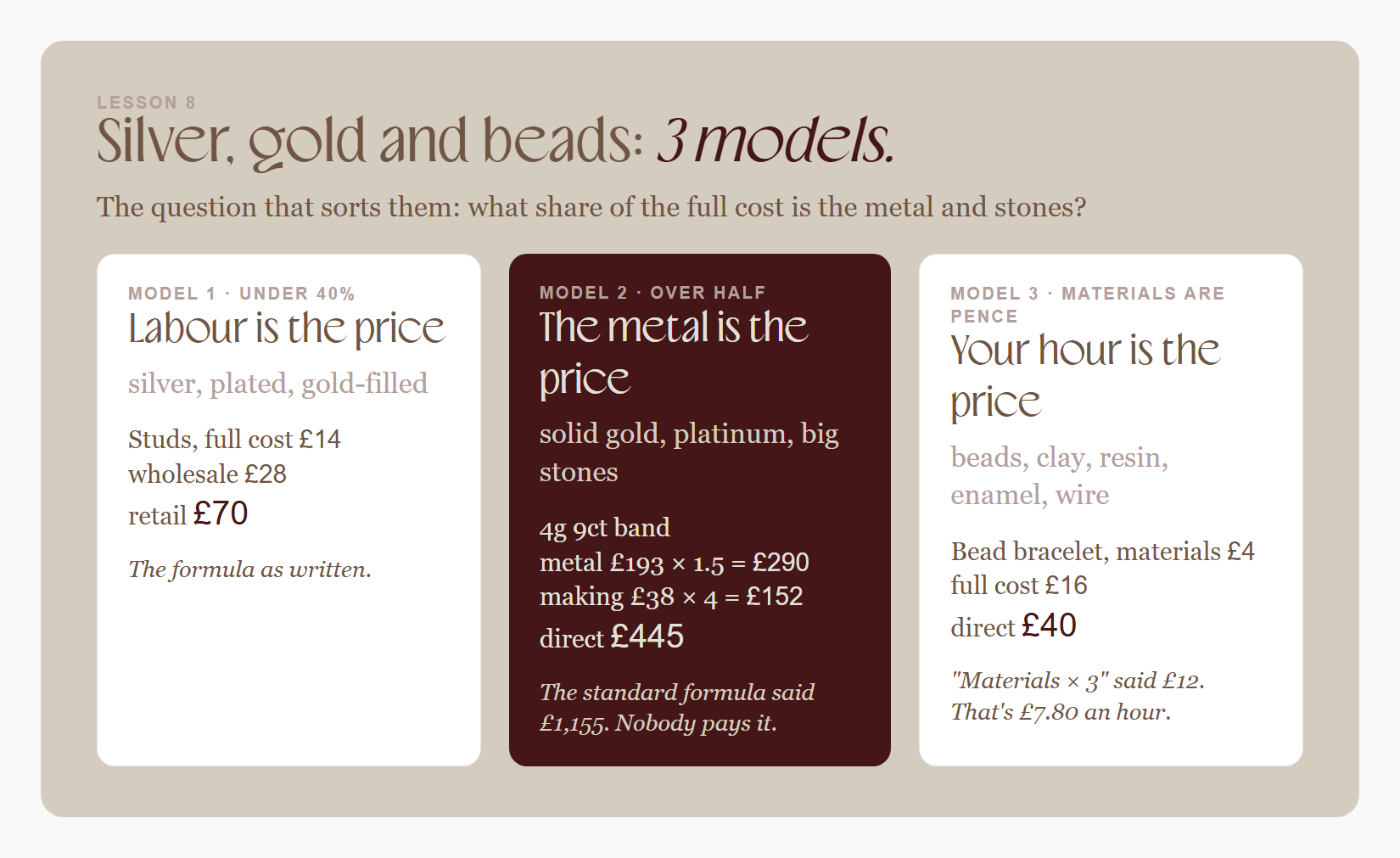
The 3 models: silver and plated, gold and stones, beads and clay
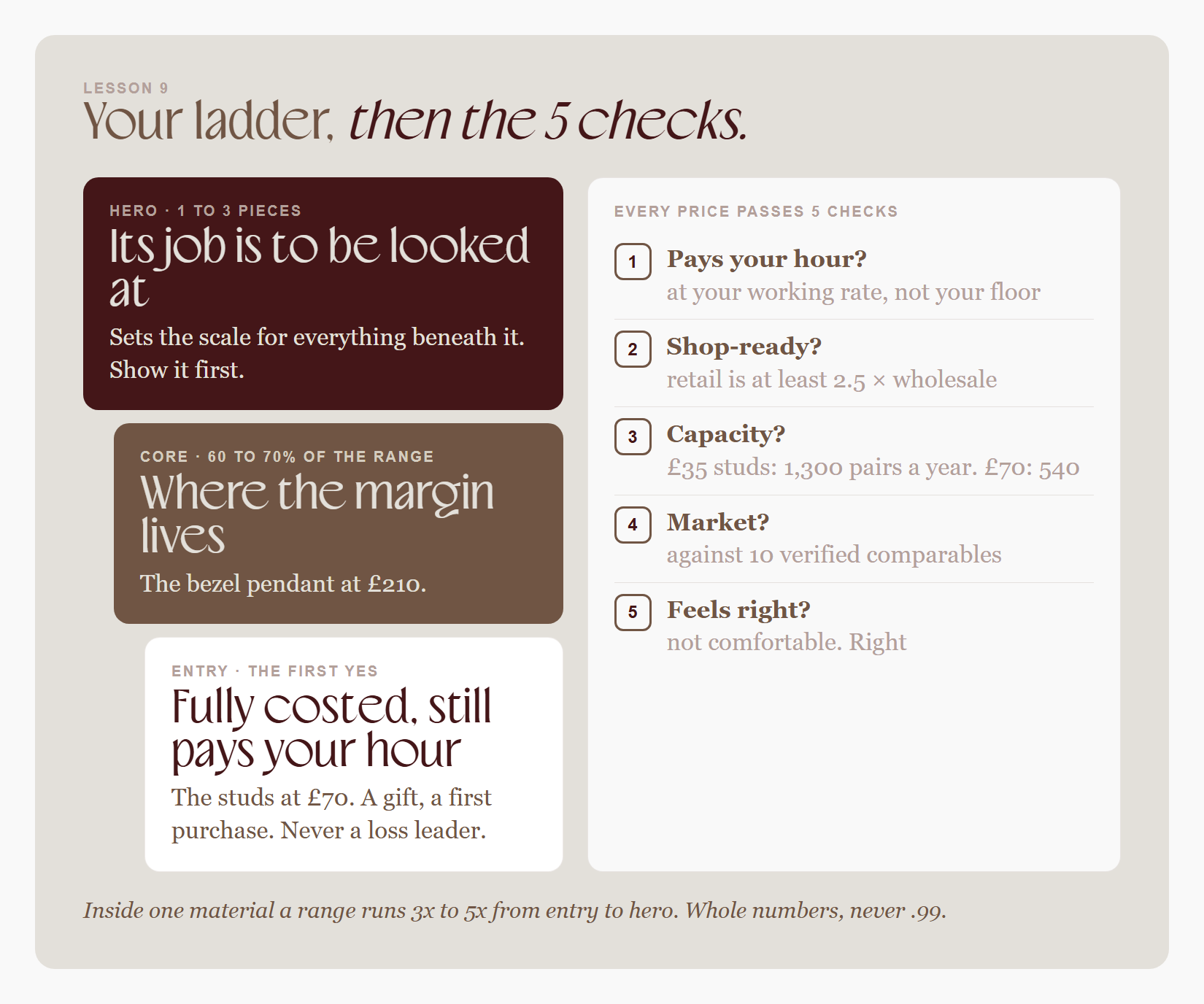
Entry, core, hero, and the 5 checks
The same £100 sale on 12 channels
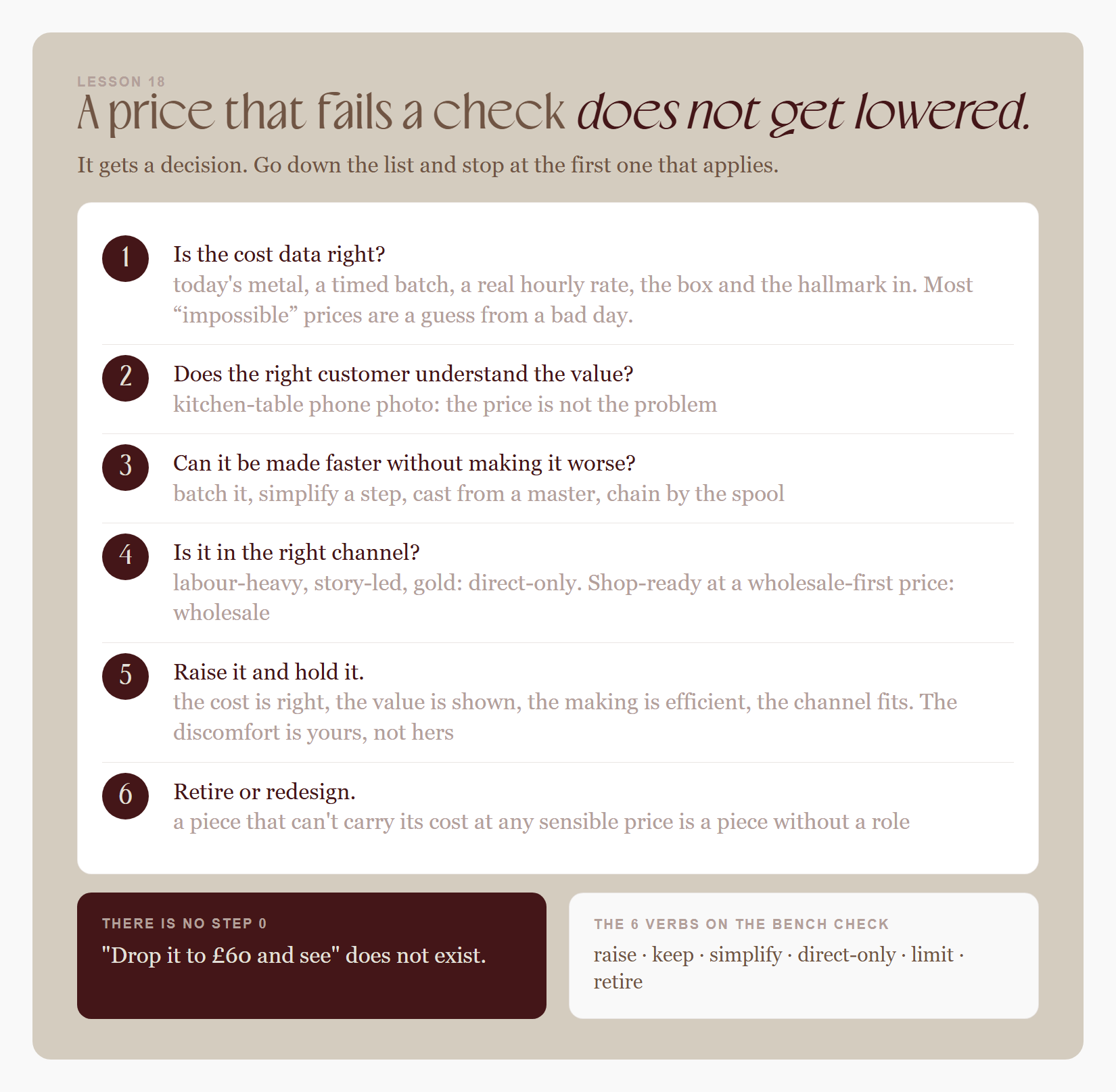
The decision tree for a price that fails a check
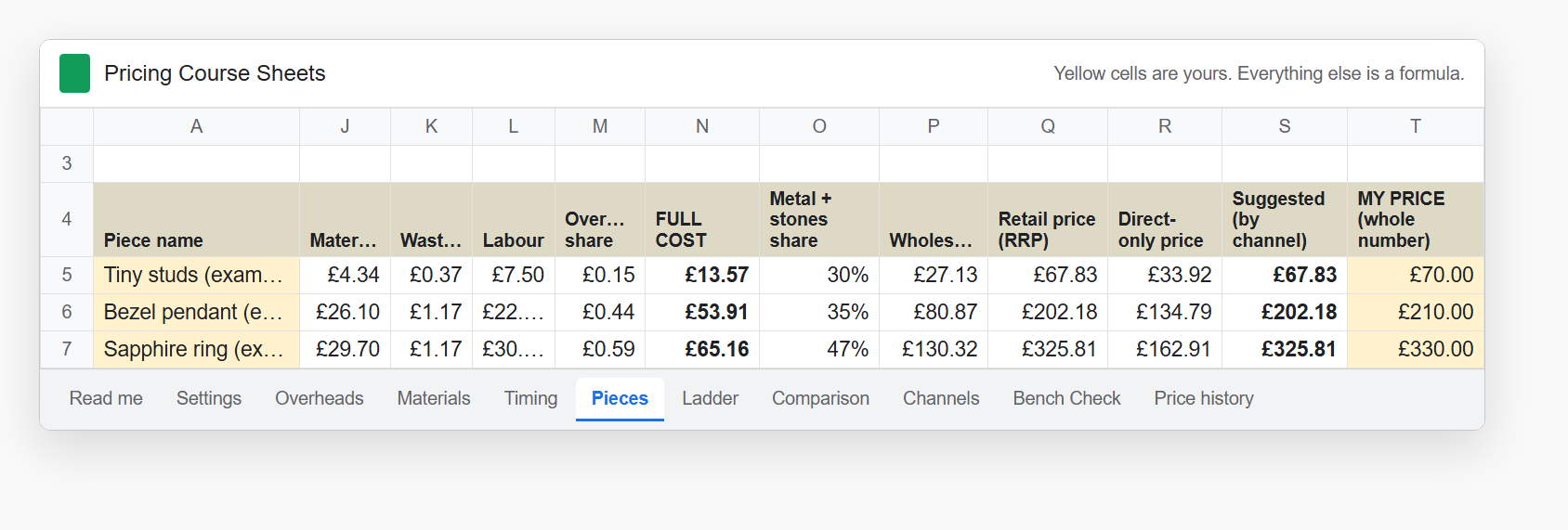
The Pieces tab of the Pricing Course Sheet: materials, labour, overhead, full cost, wholesale and shelf price for each piece

The sheet doesthe sums for you

11 tabs, one Google Sheet. You fill in the yellow cells: today’s metal price, your hourly rate, the minutes a batch takes, your overheads. Every other cell is a formula. It gives you full cost, wholesale and shelf price for every piece, what you keep on each selling channel, and a Bench Check of your top 10 with the new price and the date it goes live.

You make your own copy, so it's yours to keep, and there's nothing to subscribe to.

By the endyou’ll have

  • A full cost for your top 10 pieces, with your hour in it
  • A wholesale price and a shelf price for each one that survive any shop
  • A model for solid gold and stones, and one for beads, clay and wire
  • 10 like-for-like prices you've checked, and the habit of using them as a sense check, never a target
  • Your shipping line, your sale policy and your friends-and-family line, written down
  • The sentence you say when someone asks the price

This is for you if

  • You make and sell your own jewellery, in any material, in any country
  • You've got a feeling your prices are too low, but no way to prove it either way
  • A shop has asked about wholesale and you didn't know what to say
  • You'd rather own a sheet than pay for a tool every month

It’s not for you if

  • You want to be the cheapest. This one’s about getting paid properly
  • You resell pieces you didn't make
  • You want videos. The lessons are written, on purpose, so you can read them at the bench
Megan at her dining table, working at her laptop

I built a 6-figure jewellery brand that sold internationally, stocked at the Museum of London, Yorkshire Sculpture Park and EC One, and featured in Vogue, Glamour and Tatler. I underpriced for years first. This is the course I needed then.

One payment.Every price you’ll ever set.

Less than the margin on one underpriced pair. You could read it this weekend, open the sheet and have your top 10 repriced by Monday.

The Pricing Course

  • 16 text lessons in 6 parts, all unlocked from day one
  • The Pricing Course Sheet: a Google Sheet you copy and keep
  • The bespoke quote template and terms
  • The consignment checklist
  • The price-rise email
  • The scripts card
  • Lifetime access, and it works in any currency

£39 one payment, no subscription

Get the course

Questions before you buy

No. 16 written lessons of 7 to 9 minutes each, and the sheet. About 2 hours of reading, or an afternoon with the sheet open and your best seller on the bench.

Yes. I use pounds in the lessons because that's what I think in, and the maths is the same in dollars, euros or anything else. The sheet has one cell for your currency. Tax, hallmarking and postage are taught as "find yours", with 4 countries shown as examples.

Then you're the most underpriced maker in jewellery, and lesson 6 is written for you. There are 3 models: silver and plated, solid gold and stones, and beads, clay, resin and wire. The sheet switches the formula for you.

No. The sheet is a Google Sheet. You make your own copy and it's yours for good. It opens in Excel too if you prefer.

Lessons 10 and 11 are about exactly that: the price list a shop can stock, keystone and above, minimum orders, consignment sums, and the 6 things a consignment agreement must say.

Magnetic Jewellery Brand is the full brand programme: your USP, your customer, your identity and voice. This is pricing only, in more depth than any programme has room for, for £39.

It's a digital course with instant access, so all sales are final. If you're not sure it's right for you, email me before you buy and I'll tell you straight.

Say the numberand mean it

Your prices were probably never too high. You just weren’t paying yourself! Let’s fix that.

Get the course, £39